The story of remotely activated webcams in school laptop programs appears to be a nationwide phenomenon. The media outcry over Harriton High appears to have completely missed the fact that an even larger 1:1 educational laptop program has been using webcams for theft tracking for years as well. This great survey reporting from Philly.com shows a wide ranging reaction from school officials regarding remote laptop activation, from those that get it, to those who don't, those that are quietly deleting their webcam access, and those who... wait, huh, what?
"I didn't even know a computer has the ability to do that"- Dan Domenech, Executive Director of the American Association of School Administrators
"We had discussed it, but decided not to touch it with a 10-foot pole. ... What if it accidentally started taking pictures? ... You could have an 11-year-old child who steps out of the shower and is toweling off.You could have child pornography. ... Everything is about risk - the risk of losing a device vs. the disaster that can occur ... I would rather lose a computer than hurt a child."
- Jeff Mao, Maine Department of Education
"the McCracken County, Ky., school district began removing tracking software from laptop computers assigned to high school students. Technicians are deleting software that allows access to Web cams and monitors usage on 2,170 laptops"
"In the Henrico County, Va., public schools, which also have a large laptop program, the remotely operated Web cams are disengaged until a computer is stolen. About 26,000 laptops have been issued to students"
You read that right. Harriton is just the tip of the iceberg. Henrico County has been activating their laptop webcams too, and by their admitted numbers, more often than Harriton High:
"Henrico schools spokesman Mychael Dickerson said yesterday that the system has remotely activated cameras 50 times in the past three years to locate computers stolen from elementary schools. Those computers do not go home with students. Of those, 20 have been recovered. The other cases still are under investigation, he said."Putting aside the amazingly low success ratio apparently quoted above, this means that yet another school district is opting to take pictures of "We'll Find Out What" when laptops go missing. Or as Jeff Mao so eloquently alludes to, they're playing Child Porn Roulette and betting to win in order to find laptops. Unfortunately the ACLU has waded into the fray, armed with all kinds of crazy ideas like "search warrants" and "wiretaps", acting like a total buzzkill and basicallyspewing common sense everywhere:
"In May of 2009, NBC12 reported the theft of several laptops from Pinchbeck Elementary School. School officials used the police report number -not a warrant- to activate a camera which clearly revealed the suspect, who was arrested a week later, and eventually pled guilty. Now, the ACLU claims that could be an illegal invasion of one's privacy...even that, of a thief."
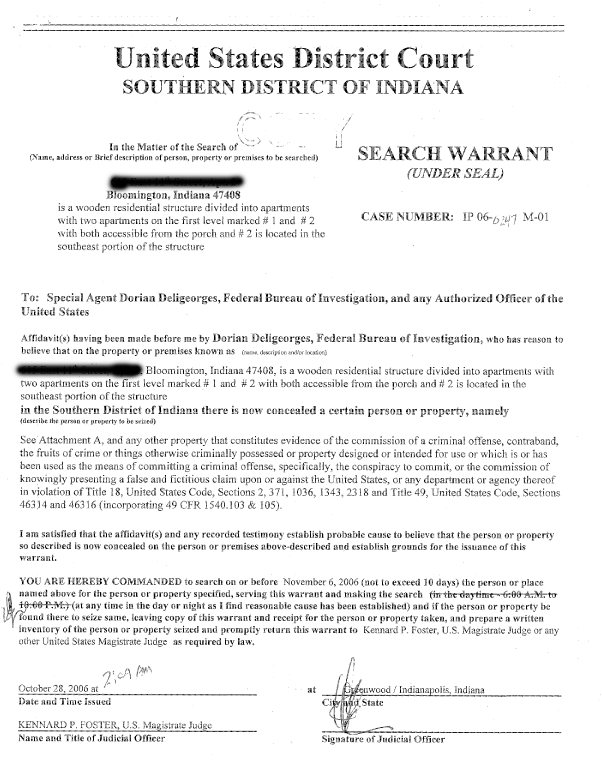
My personal favorite part of this article is the reporter's shocked tone at the idea that accused criminals have rights. But it's important to note that a warrant was never issued for this search. And that brings me to a really important question regarding search warrants, and their eventual use in programs like this. How does one fill out a webcam search warrant?
We're Going to Search... Something!
If you take a look at the top of the form, you'll see "Name, Address ... premises to be searched". This has always been a part of search warrant forms. With the way webcam theft tracking works, we'll need a new type of search warrant: Location To Be Determined After Search. When these laptops wake up and retrieve orders to activate their webcams, they can literally be anywhere. They can be in a child's bedroom, in a foreign embassy, in a conference room in the hands of someone who inadvertently purchased a hot laptop off Ebay, in a SCIF, or anywhere else in the world. And so, we will need to be able to write search warrants that are valid anywhere on the planet. Or, just maybe, that's impossible, and the process of having to get a search warrant in the first place will reveal how truly ludicrous this entire scheme really is. For now, that quiet whirring sound is the sound of administrators across the country deleting their webcam folder.